Satire on Westernization and "luxurious living"
Dead SoulsThe satire of Westernized reform and the pursuit of “higher amenities of life” exposes a recurring confusion in Dead Souls: the belief that imported fashions, grand institutions, and new comforts amount to genuine progress. Colonel Koshkarev’s estate gives this confusion an absurdly visible form, while Kostanzhoglo offers a competing ideal grounded in practical knowledge and agricultural work. The critique widens beyond individual landowners to provincial society, where luxury is financed by debt and anticipated corruption. Its target is not learning or improvement in themselves, but reform detached from the country it claims to improve.
Koshkarev’s estate as reform in caricature
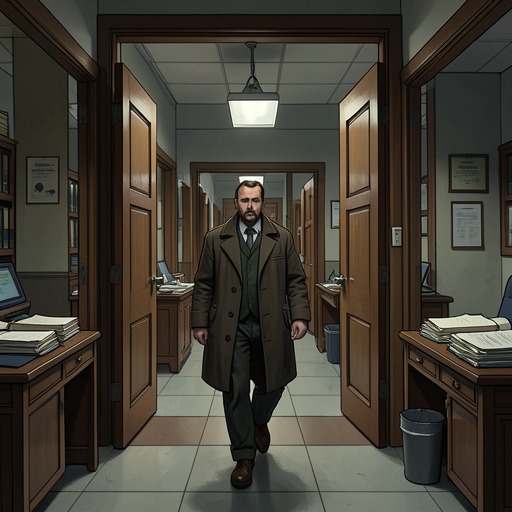
Koshkarev’s property appears, at first, to be organized for relentless improvement. Chichikov arrives after half an hour’s drive to a village crowded with building and repair work: alleys are obstructed by lime, bricks, and beams, while huts have been repurposed as offices. Gilt-lettered signs identify a Depot for Agricultural Implements, a Chief Office of Accounts, an Estate Works Committee, and a Normal School for the Education of Colonists. The landscape makes administrative ambition physical; its accumulating projects and departments promise order, yet their proliferation already hints at confusion.
Behind a desk with a pen between his teeth, Koshkarev welcomes Chichikov civilly and recounts the effort required to bring the estate to affluence. He complains that the peasants do not understand the incentives offered by science and art. His examples expose the distance between his program and their circumstances: he has not persuaded the female serfs to wear corsets, while he invokes German millers’ daughters who can play the piano. He imagines peasants walking behind the plough while reading Franklin on electricity, Virgil’s Georgics, or a treatise on soil chemistry. The intended image of enlightenment is comically detached from the work it is supposed to accompany.
Koshkarev’s ambitions extend from education to national transformation. He claims that if Russian peasants could be persuaded to wear German clothes, science would advance, trade would grow, and a Golden Age would dawn. Chichikov, whose purpose is simply to acquire souls and confirm their purchase, listens before trying to redirect the conversation to his business. The contrast is pointed: Koshkarev mistakes procedural and cultural reform for a universal program, while Chichikov is concerned with a specific transaction. Neither conversation nor the elaborate establishment makes the system function effectively.
Committees, paperwork, and borrowed models
When Koshkarev treats Chichikov’s request as a Statement of Plea, the visitor is sent to an official called the Commissioner. Their search reveals not a smoothly operating bureaucracy but a chain of displaced offices. The Committee for the Reception of Reports and Returns has shut its doors because its director was transferred to a newly formed Committee of Estate Management, and the director’s successor was attached to the same committee. The Department of Estate Affairs is under repair; its only respondent is a drunken peasant who cannot offer a coherent answer. Each institutional complication turns reform into delay and bewilderment.
The Commissioner remarks that the Committee of Management takes men away from their proper work and assigns them elsewhere, even though everything apparently has to pass through it. Chichikov returns to report that the office for receiving reports and returns has ceased to exist. Koshkarev responds not by resolving the immediate disorder but by writing eight searching questions under three headings about jurisdiction, appointments, and the vanished office. His indignation may be genuine, but the scene’s joke is structural: the machinery generates further questions and documents instead of accomplishing the task for which it exists.
Kostanzhoglo later interprets Koshkarev as a caricature of intellectuals who borrow foreign ideas without first learning their own country. He connects this fashion to landowners who establish offices, factories, schools, and commissions, and says that the reconstruction of affairs after the French War of 1812 has been carried out worse than a Frenchman would have managed it. His criticism is not simply of foreign influence; it is of imitation without judgment, which makes institutional display a substitute for competent stewardship. The comparison with Peter Petrovich Pietukh, whom he calls a good landowner by contrast, sharpens the satire of standards lowered by fashionable but ineffectual reform.
Agriculture against fashionable improvement
Kostanzhoglo’s alternative begins with limits and practical work. He objects to every landowner becoming a mechanic and going abroad for an instrument to open what could be opened by simpler methods. In his view, the traveler may return from abroad more ignorant than before. He also fears that education, received without knowledge of the country, produces a kind of Quixotism: landowners establish schools in pursuit of philanthropy, but the resulting workmen are of little use either in town or country. He argues that the peasant should first be made prosperous and become a good farmer; education, he says, will follow more readily from that foundation.
His defense of the agriculturist is deliberately polemical. Kostanzhoglo treats the Russian agricultural worker as the most respectable social figure and asks why that class should be altered to satisfy advocates of luxury. He warns that making peasants yearn for comforts beyond their station could leave them diminished rather than improved. The force of his argument lies in the opposition between a livelihood based on productive competence and reforms that manufacture appetites without securing the means to meet them. At the same time, his sweeping assertions remain part of a heated character’s speech; the novel stages his convictions as a counterpoint to Koshkarev, not as a neutral policy statement.
The contrast also appears in Kostanzhoglo’s account of his own reputation. Provincial gossip calls him a miser and usurer, while his accusers defend their spending by claiming that they have encouraged industry through the “higher amenities of life.” They disparage his way of living as piggish. Chichikov replies that he would be glad to live in such a fashion. Kostanzhoglo rejects the presumed value of these amenities: a landowner may establish a library without reading its books and soon return to card-playing, while social judgments condemn him for not spending on dinners. He says that he welcomes a visitor for a simple meal, and distinguishes wasteful display from lending money to someone who explains a sound use for it. His self-defense makes the debate concrete: restraint and selective assistance are set against expenditure undertaken for status.
Luxury, debt, and provincial consequences
The satire reaches beyond the estates when Chichikov’s journey is delayed by bad roads and preparations for a second fair, intended for the nobility. The earlier fair had sold horses, cattle, cheese, and other peasant produce to cattle dealers and middlemen; the new occasion centers on manorial goods purchased wholesale at Nizhni Novgorod. The difference in merchandise marks a shift from rural production toward the consumption of fashionable commodities. The narrator describes foreign merchants and fashions as drawing away money earned through hard labor, extending Kostanzhoglo’s complaint about imported luxury into a view of the province’s economy.
A poor harvest keeps many landowners in the country, but the provincial officials, whose circumstances are not directly affected by the crop failure, and their wives indulge in new luxuries. Books promoting superior amenities have encouraged a taste for experimentation. A French wine merchant opens a restaurant where half the supper can be bought on credit and the remainder at an exceptionally low price. The arrangement suits board chiefs and clerks who hope to resume taking bribes from petitioners. Luxury is therefore not merely a matter of personal taste: the scene links consumer appetites to debt and to the expectation of renewed official corruption.
The same competitive display appears in horses and liveried servants. Despite damp, snowy weather, elegant equipages parade through the province, their appearance comparable to those of St. Petersburg. Merchants and attorneys tip their caps to ladies, while the bearded man in a rough fur cap becomes rare; clean-shaven faces and dirty teeth mark the adoption of a European fashion. The juxtaposition makes the transformation deliberately unstable: outward polish does not signify deeper refinement. Across Koshkarev’s gilt signs, Kostanzhoglo’s quarrel over amenities, and the provincial parade of borrowed styles, the novel measures reform by what it does for the country and its people, not by how foreign or impressive it looks.